
A CLEAR FIRST RUN
Your first device.
Your first routine.
Set up Screen Parent, install the child application, then check one simple rule together. Windows and Android use different installation paths.
1. Create your family in Screen Parent.
Use the parent web app to manage your family from a browser. After signing in, open Account, add a child profile and confirm the child's time zone. Daily limits and reward expiry use that time zone.
You can install Screen Parent as a web app using your browser's install option, or Add to Home Screen where supported. A parent web app installation manages other devices; it does not monitor the phone or computer you installed it on.
For another parent or carer, use account sharing and an invitation. Each person signs in with their own account. A carer invitation is separate from the temporary phrase used to link a child device.
2. Install the child application.
| Application | Use it for | Download |
|---|---|---|
| Windows bundled installer | Desktop, monitoring Agent and Supervisor together. Installs both Windows components listed below. | Download Windows bundle Bundle release notes |
| Windows Desktop | The child-facing application. Install alongside the Windows Agent. | Download Desktop 1.3.31 Desktop release notes |
| Windows Agent | Background monitoring and enforcement. Install alongside Windows Desktop. | Download Agent 1.7.31 Agent release notes |
| Android app | The interface and native monitoring in one signed APK. | Download Android build 14 |
| Android provisioner | Windows setup tool with an Android APK included. Check its release notes for the included build. | Download Provisioner 0.2.8 |
For Windows, install both Desktop and Agent. If a Normal-channel combined installer is available, it appears above and installs both components together.
Saved Normal-channel downloads are shown. Enable JavaScript to check for newer Normal builds.
Downloads use the newest published Normal-channel version of each application. Preview builds are excluded. Read the Windows release notes beside each download and the Android and Provisioner release notes before installation.
Windows: install Desktop and Agent
- Download both Windows x64 installers above, or use the combined installer when available.
- Run the installers with administrator access and choose the Windows accounts that should use Screen Goal.
- Open Desktop, complete local setup including the administrator PIN, and link the device to the parent account.
- Check monitoring is running and that new activity appears in Screen Parent.
Windows installation and updates: For signed Windows installers, check that the publisher is Netambition Pty Ltd. Supervisor-managed automatic updates require a trusted signed installation and a newer trusted signed release on the Normal channel. Being on the Normal channel alone does not establish that a build is signed or that automatic updates have been verified; read the release notes for installation and update limitations.
If you already have a newer version installed, keep it installed rather than downgrading to an older Normal release. Automatic updates only install newer versions. Moving from an unsigned installation to a signed version requires manual installation with administrator access.
The separate Android Provisioner includes its own Android APK. Its release notes identify the included build, which may differ from the latest standalone Android download.
Windows native push notifications additionally need Windows App Runtime 1.7 x64 and a configured notification service. Push delivery is separate from basic monitoring and the in-app inbox.
Android: install, grant permissions, then link
- Use the Provisioner on a Windows computer with the Android device connected by USB, or download the Android APK above and open it on the child device. For a manual APK install, Android may ask you to allow installation from your browser or file manager.
- Open Screen Goal and follow its setup checklist. Usage Access provides activity monitoring; display-over-other-apps permission allows warning and block overlays.
- Enable notification permission where requested. Enable Accessibility content access if you want supported browser and content monitoring.
- Enable foreground and, where requested, background location if you want the parent to request a device location while the app is in the background. Camera access is requested when a child takes task evidence.
- Link the device, start monitoring and use the checklist to recheck any missing permission.
For the tamper guard, enable Accessibility and open Screen Goal → Settings → Blocking → Parent protection & maintenance. Enable protection with your parent PIN. A — Easier Set Up provides a best-effort settings guard; it does not give Android-enforced uninstall protection. Use PIN-authorised maintenance to change permissions. After USB setup, turn off USB and wireless debugging.
To receive protection emails, open Screen Parent → Account → Devices → Diagnostics → Android protection and enable email alerts for the account owner. A missing check-in alone does not prove tampering.
For stronger app-launch protection, read managed Android setup before provisioning. Device-owner setup can require a fresh or reset device. Back up anything needed and follow the provisioner's device-specific instructions. A managed profile controls only its own profile.
3. Link with a temporary phrase.
- In Screen Parent, open Account → Add device → temporary linking phrase.
- Keep the phrase private. On the child's device, open Account → Link Device and enter it.
- Wait for the successful linking confirmation. The device must be online to redeem the phrase and save its identity.
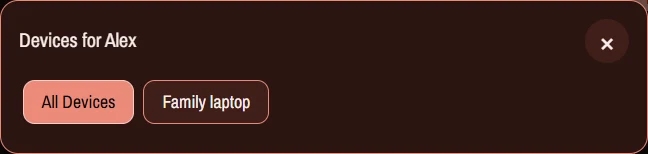
- Back in Screen Parent, confirm the device is assigned to the right child. Choose the child and use Change to select a device or All Devices.
If a phrase has expired or was already used, create a new one. If linking reports that it could not persist the native device identity, update and reopen the Android app before retrying. Do not share the phrase or device credentials when asking for support.
4. Check one rule before adding more.
- Choose the child and intended device scope.
- In Limits, set a modest daily allowance and an allowed period that includes the current time.
- Use a normal monitored app briefly on the child device. Refresh the parent view and check the report.
- Make a small allowance change, reopen Limits on the child device and confirm it has arrived. Remote changes need connectivity and sync.
- Set an advance warning and confirm the chosen warning/blocking behavior together.
Keep essential access in mind when choosing Always allowed exceptions. Unlimited removes an app's own quota; other daily, category, schedule and blocking rules can still apply.
5. Add one Activity they can finish.
Open Activities → Plan → Create activity. Write a short title and clear instructions, choose Must do or Optional, and set the reward. Start with a parent-reviewed activity worth 15 minutes of bonus time.
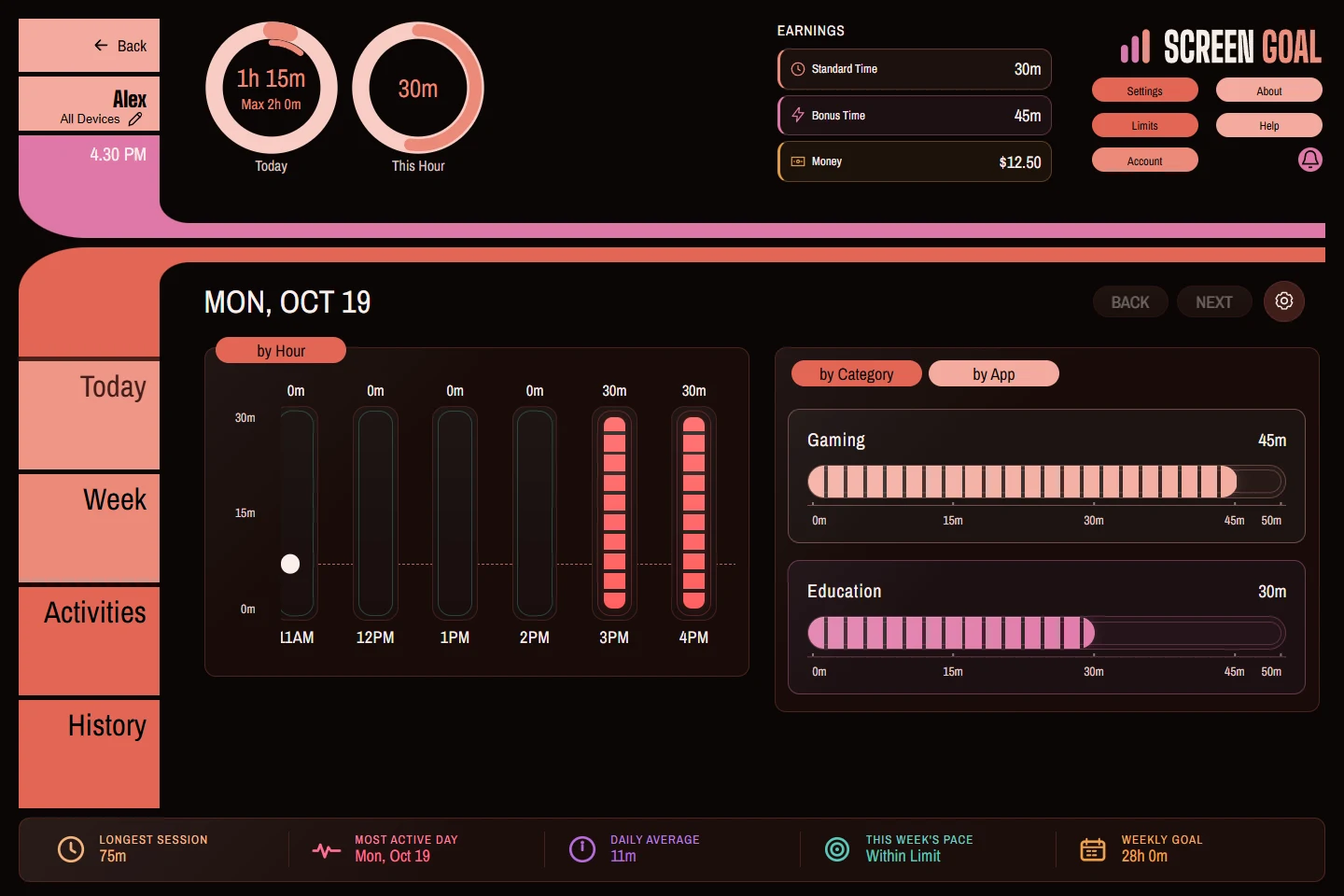
The child starts and submits it on their linked device. You review the submission in Screen Parent. Acceptance credits the child's reward balance; the child then redeems time in 15-minute steps. A pending submission is not spendable time.
For chores that release part of the regular allowance, use Standard time and read the withheld-time example first. For pocket money, Screen Goal records balances and requests; it does not send money.